

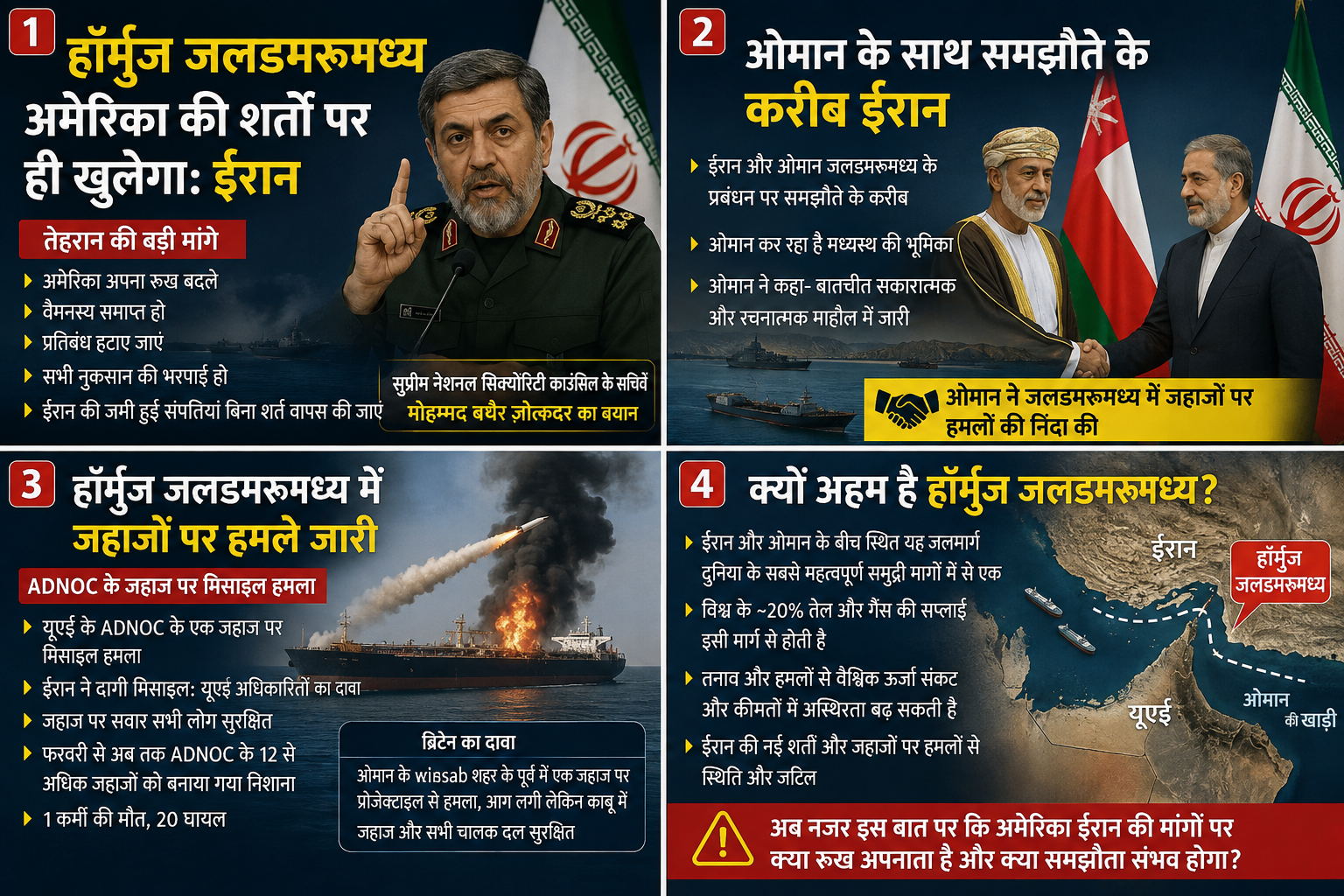

Iran-US Standoff Deepens Over Key Waterway
Iran stated that the Strait of Hormuz would only be opened if the US improves its attitude.
Tehran demanded an end to hostilities, the lifting of sanctions, and full compensation for damages.
Iran is nearing an agreement with Oman regarding the management of the Strait of Hormuz.
Dubai: Iran has placed several major conditions before the US regarding the opening of the strategically vital Strait of Hormuz. Iran's Supreme National Security Council has stated that the strait will not be opened until the US changes its stance. These new demands from Iran could further complicate ongoing negotiations concerning this waterway. Iran's state broadcaster released a statement from Mohammad Bagher Zolqadr, Secretary of the Supreme National Security Council; Zolqadr is also a commander in the powerful Islamic Revolutionary Guard Corps. Notably, US President Donald Trump had previously claimed that the Strait of Hormuz could be opened this week.
Iran's major conditions for the US
Iran has stated that the US must never threaten Iran in the future. Furthermore, the US must permanently end hostilities against Iran and its allied armed groups in the region. Iran demands that the US immediately lift the ongoing naval blockade of Iranian ports and withdraw its military presence from the region. Additionally, Iran has demanded full compensation for damages incurred due to the conflict. It has also called on the US to lift sanctions and unconditionally release Iran's frozen assets. There has been no immediate response from the US regarding these demands; the US seeks an acceptable agreement concerning the Strait of Hormuz before discussing the lifting of the blockade.
Iran nearing agreement with Oman
Iran has already stated that it is close to reaching an agreement with Oman regarding the management of the Strait of Hormuz. Oman, an Arab nation in the Gulf, is playing the role of a mediator in this matter, although it has so far disclosed very little information about the negotiations. On Saturday, Oman stated that talks between the two sides were continuing in a "positive and constructive atmosphere." Oman also condemned the attacks on ships in the strait.
**Claim of missile attack on a ship**
Meanwhile, a vessel belonging to ADNOC—Abu Dhabi’s state-owned oil and gas company—was attacked while passing through the Strait of Hormuz. UAE officials reported that Iran fired a missile amidst the ongoing attacks on commercial vessels. However, immediate details regarding the exact location of the attack or the damage sustained by the ship were not provided. ADNOC stated that there were no casualties in the attack, which occurred early Saturday morning. According to the company, more than a dozen of its vessels passing through Hormuz have been targeted by missiles and drones since the conflict between Iran and the US/Israel began in February. The company reported that one crew member died and 20 others were injured in these attacks.
**Britain also reports ship attack**
Later, the UK Maritime Trade Operations center reported that a ship had been struck by a projectile east of the Omani city of Khasab. A fire broke out on the vessel following the attack but was brought under control. British officials stated that the ship and all its crew members are safe. However, it was not immediately clear if this was the same incident in which the ADNOC vessel was reported to have been targeted.
The Strait of Hormuz, situated between Iran and Oman, is one of the world's most vital maritime routes. Prior to the outbreak of hostilities, it was regarded as an international waterway. Iran and Oman are currently negotiating an agreement regarding the management of this waterway. In this context, Iran's new conditions and the attacks on ships could further complicate the situation. Attention is now focused on the stance the US will adopt regarding Iran's new demands and whether both sides, with Oman's mediation, can reach an agreement concerning the Strait of Hormuz.
You Might Also Like
-
Israeli media had claimed that Iran's Supreme Leader, Mojtaba Khamenei, was in critical condition an...
-
Trump claims US blockade is as strong as a ‘wall of steel’ Demand for compensation for US families...
Leave A Comment







Comments