

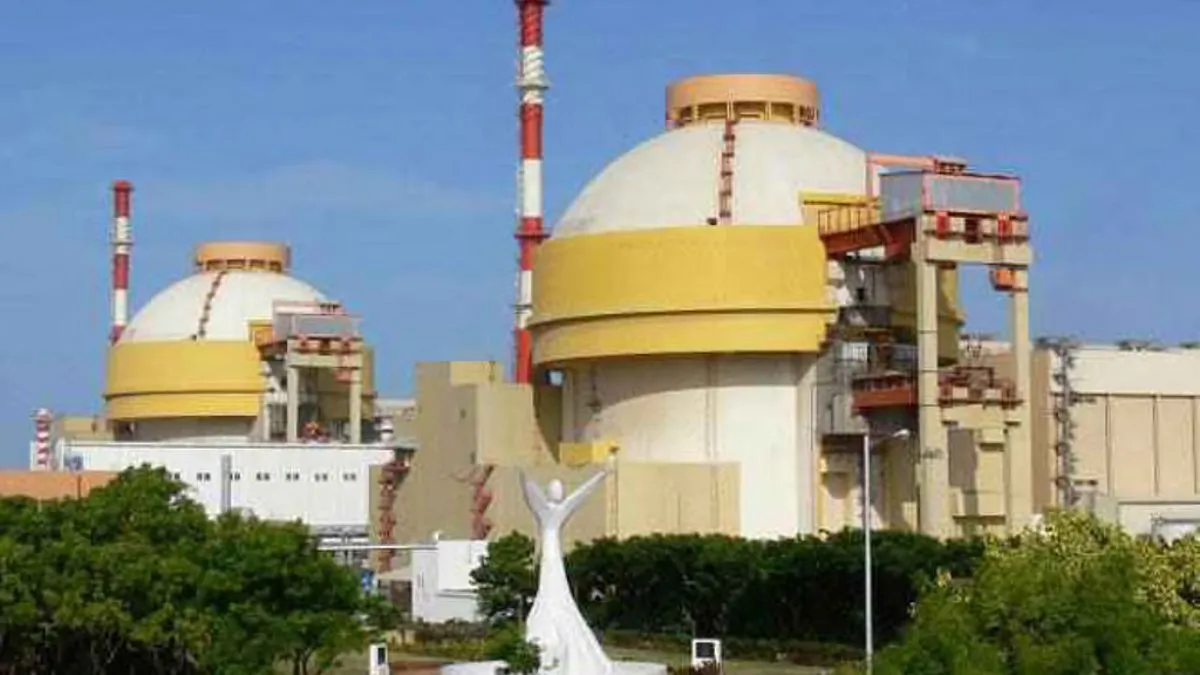

Liability for nuclear accidents will be determined, and AERB will be given legal status.
New Delhi: The government introduced the Sustainable Harnessing and Advancement of Nuclear Energy for Transforming India (SHANTI) Bill 2025 in the Lok Sabha on Monday. This bill will bring about a major change in India's civil nuclear system. This will end the decades old government monopoly and private companies will also be able to participate in this sector. If this bill is passed by both Houses of Parliament, the Atomic Energy Act of 1962 and the Civil Liability for Nuclear Damage Act of 2010 will be repealed. Both of these laws were considered a major barrier to investment by industry and foreign partners.
Why was the bill brought? Jitendra Singh said
Minister of State Jitendra Singh in the Prime Minister's Office said, 'This bill will provide a practical civil liability regime for nuclear damage and will provide legal status to the Atomic Energy Regulatory Board.' According to the government, the peace bill is linked to India's larger goals. This includes increasing the share of nuclear energy in the country's energy, promoting new discoveries in nuclear science and technology, expanding uses other than electricity and fulfilling international obligations on nuclear safety, security and safeguards.
The biggest change in the SHANTI Bill is that Indian private companies will be able to obtain licenses to build, own, operate and decommission nuclear power plants and reactors. So far this work was mainly limited to joint ventures between the Nuclear Power Corporation of India (NPCIL) and other government companies. In the bill, responsibility for nuclear accidents has been placed solely on the plant operator and equipment suppliers have been exempted. This will remove a major concern of foreign sellers. The maximum liability for each nuclear accident will be Rs 300 million equivalent to the Special Drawing Rights (SDR) set by the IMF, which is in line with international standards.
Operators are required to maintain an insurance or liability fund of $11 million to $330 million, depending on the size of the reactor. There will be a separate nuclear liability fund for claims above this and the government will help if the damage is more than the cap. Private companies registered in India can also carry out activities such as manufacturing of nuclear fuel, transportation and storage of nuclear and spent fuel, and import-export of fixed equipment, technology or software. But companies registered outside India or foreign controlled companies cannot take license. Also, sensitive work like fuel enrichment, spent fuel reprocessing and heavy water production will remain in the hands of the government only.
Why is the SHANTI bill so important?
The bill is linked to India's climate goals, which include achieving net-zero emissions by 2070 and increasing nuclear power capacity to 100 GW by 2047 from the current 8.2 GW. To achieve this goal, the government has emphasized better utilization of indigenous nuclear resources, public and private sector participation, and making India a significant contributor to global nuclear energy. Major Indian companies such as Tata Power, Adani Power and Reliance Industries have shown interest in investing in nuclear energy.
At the same time, foreign suppliers such as Westinghouse, GE-Hitachi, France's EDF and Russia's Rosatom have expressed their willingness to partner with Indian companies. The bill also provides various exemptions such as that the operator will not be responsible for damage to nuclear installations under construction, other installations on the same site, related property or transport carrying nuclear material.
Rules and regulations of security
The bill will give legal status to the Atomic Energy Regulatory Board (AERB), which currently operates by executive order. This will strengthen safety and monitoring. Also, Atomic Energy Redressal Advisory Council will be constituted to settle the dispute. There will be strict punishment for violations such as a fine of up to 5 lakh rupees for small mistakes, while for serious offenses up to 1 crore rupees. All operators, government or private, have to obtain a license from the government and safety clearance from the AERB. Foreign controlled companies will not get a license. If this bill becomes a law, it will not only bring about a historic change in India's nuclear policy but also pave the way for investment worth billions of rupees.
You Might Also Like
-
New Delhi: This serves as a prime example of how time itself often provides the answers to certai...
-
It is well known that Bangladesh, Sri Lanka, and the Maldives have, in the past, spoken out again...


Leave A Comment










Comments