

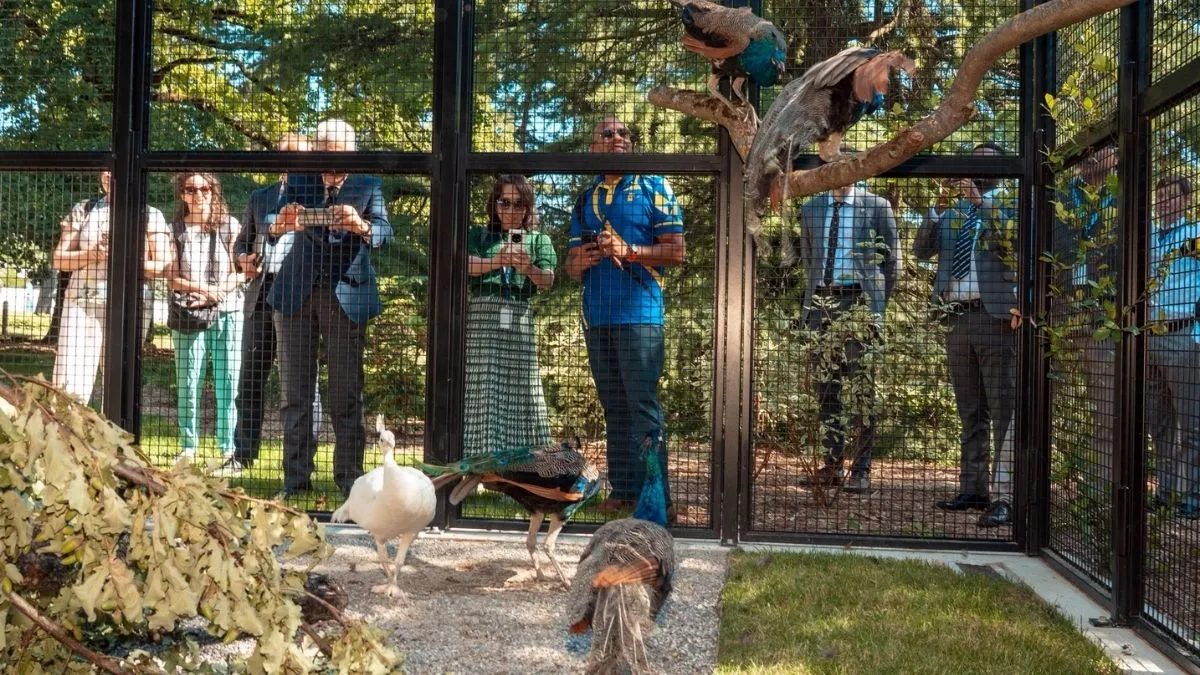

India Revives Peacock Tradition at UN Geneva After 45 Years
India gifted four blue peacocks and one rare white peacock to UN Geneva.
A tradition initiated by Indira Gandhi in 1981 continues with the arrival of these five new peacocks.
Experts will keep a close watch to ensure the peacocks' safety, particularly against foxes.
Geneva: Five new peacocks gifted by India have arrived at the United Nations Office at Geneva. These peacocks have been housed within the grounds of the 'Palace of Nations' in Switzerland. This gift from India upholds a long-standing tradition and reflects the enduring relationship between India and the United Nations. India's Permanent Mission to the UN described this as a new dimension of the partnership between India and the UN. The Mission wrote on X, "Another dimension of partnership. India has gifted five young peacocks to UN Geneva. As the national bird, the peacock holds a special place in the heart of every Indian."
UN Geneva also welcomed this gift from India. UN Geneva wrote on X:
"Forget panda diplomacy. Five young peacocks have arrived at UN Geneva. They are a gift from India, continuing a tradition that predates the United Nations itself. Meet Geneva's newest and most magnificent 'diplomats'."
It is worth noting that China is known for its 'panda diplomacy'. As for these five peacocks, the group consists of four blue peacocks and one rare white male peacock. The primary objective of bringing them in is to replenish the peacock population within the UN Geneva complex, where the number of peacocks had dwindled to just a single bird.
Peacocks to stay in a special enclosure for three months
The new arrivals have currently been placed in a large, temporary aviary constructed in Ariana Park. Here, they will acclimatize to their new surroundings. After approximately three months, they will be permitted to roam freely within the complex grounds. Tatiana Valovaya, Director-General of UN Geneva, said:
"We are delighted to welcome five new peacocks. Among them are four blue peacocks and one white one—colors that also align with the United Nations' traditional blue and white. We have built a temporary home for them; they will stay here for the next three months, after which they will be allowed to roam freely and enjoy the hospitality of Ariana Park."
**India Gifted Peacocks to the UN in 1981 as Well**
The story of peacocks shared between India and the United Nations is not new. In 1981, the then Prime Minister Indira Gandhi sent a pair of peacocks to Geneva. Arindam Bagchi, India's Ambassador and Permanent Representative to the UN, expressed happiness at continuing this tradition. He said:
"It is truly a matter of pride for the Indian Mission that we are able to gift five peacocks—*Pavo cristatus*—to UN Geneva. There has been a tradition of keeping peacocks here; we gifted peacocks in 1981 as well, and we are happy to carry this tradition forward."
**Peacocks Arrived in Geneva via a Special Ambulance**
Special arrangements were made to transport the peacocks safely to Geneva. According to UN News, the Geneva Biopark transported them in a specially equipped ambulance. This vehicle was fitted with medical facilities tailored to the birds' needs. Veterinarian Dr. Tobias Blaha noted that the UN complex is an ideal habitat for peacocks. He said:
"It is a dream habitat for them. There is no need to keep them in an aviary for long. The grounds feature ancient trees, shaded areas, a variety of flowers, and vast grassy expanses."
**Protecting Them from Foxes: The Biggest Challenge**
However, experts also face the challenge of ensuring the safety of these young peacocks. Local foxes could pose a threat, so they will need to be closely monitored during the initial period. Dr. Blaha explained that the young peacocks are not yet accustomed to living in a large, open park. He said,
"They often sleep on branches that aren't high enough to keep them safe from foxes. So, we have to keep an eye on the situation. The higher they sleep, the lower the risk, because foxes cannot climb trees."
"Hoping for peaceful coexistence"
A notable feature of these five peacocks is that they are all young males born this year. Officials hope that growing up together will foster peaceful coexistence among them. Laetitia Menin, Facilities Management Officer at UN Geneva, noted that the fact that they are all males will simplify the dynamics of their group. She said,
"Since they are all males born this year, they will establish their place within the group as they grow up together. We hope this means that in the spring—when hormones kick in and peahens are present on the grounds—they won't wander off."
Where did the tradition of keeping peacocks begin?
The tradition of keeping peacocks on the UN Geneva grounds predates the United Nations itself. The estate's original owner was Gustave Revilliod, who gifted the entire property to the city of Geneva in 1890. A condition of the handover was that peacocks be allowed to roam freely on the premises. Over the decades, the peacocks became an integral part of the site's identity. Today, they are also a major attraction for visitors to this diplomatic complex. Now, special preparations are underway for these five new peacocks. According to UN News, a naming contest for the general public will soon be launched to decide the names of these five new arrivals.
You Might Also Like
-
Russia Forms New Brigade of Former Ukrainian Soldiers A report highlights another strategy employed...
-
'Mosquito nets' strung over Kharkiv's streets Images emerging from Kharkiv reveal a different side...


Leave A Comment






Comments